
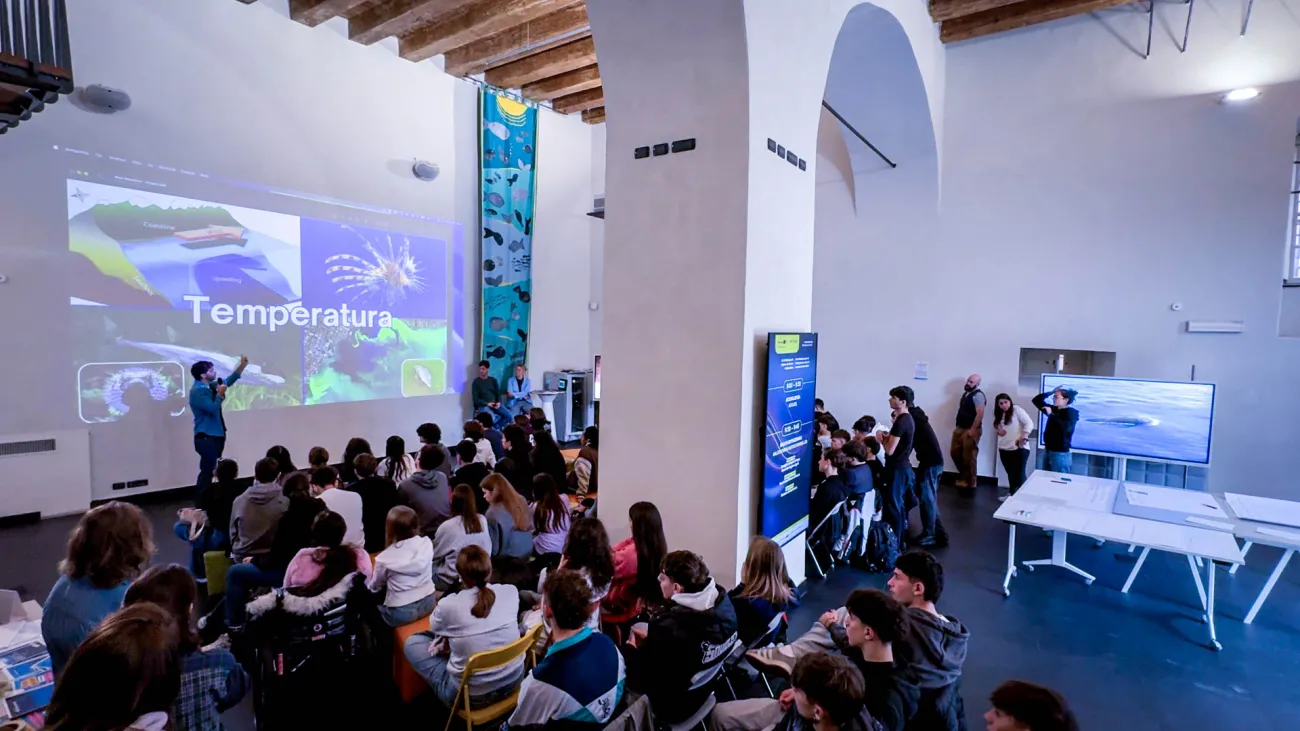
The public presentation at the Blue District in Genoa marked a crucial step in the project.
In the morning, we met with around 80 high school students from artistic and scientific backgrounds. Rather than a traditional lecture, the session became an open dialogue. We presented the environmental challenges behind Posidonia Art Reef, the scientific framework, and the idea of an underwater museum co-created with the community.
Through guided discussion and workshop activities, students explored how art can generate ecological awareness and how form can become habitat. Ideas circulated quickly — bold, symbolic, imaginative.
In the afternoon, the space opened to an adult audience. Citizens, professionals, and sea lovers gathered to learn more about the project’s goals and constraints. Together, we reflected on the relationship between biodiversity, participation, and artistic responsibility.
It was during one of these exchanges that the defining intuition emerged — from a 16-year-old participant.


From Hands to Reef: Designing the Sculpture
Once the concept was defined, the work moved into the digital realm.
The sculpture began with a physical gesture: a 3D scan of real hands. These hands were then reconstructed and refined in digital modeling, becoming the structural base of the piece.
They hold an artificial reef shaped like the world.
The globe is intentionally perforated — carved with cavities, tunnels, and openings designed to host marine life. Each void becomes a potential refuge for fish, octopus, and invertebrates. The internal geometry was studied in relation to Mediterranean species, considering dimensions, swimming behaviour, and ecological function.
The sculpture is both symbolic and functional.
Hands supporting the planet — not as an abstract message, but as a living habitat.


Layer by Layer: Printing in Concrete
The final stage is currently underway.
The sculpture is being 3D printed in marine-compatible concrete by D-Shape, layer by layer. The additive manufacturing process allows precise control over density, cavities, and structural stability, ensuring durability while maintaining ecological sensitivity.
Unlike traditional casting, this method reduces material waste and allows the complex internal morphology necessary for marine colonisation.
What was once an idea shared in a workshop is now taking physical form — stratified, solidifying, preparing to meet the sea.
Soon, the hands will rest on the seabed.
And the reef will begin its own transformation.


